
Lab Grown Diamond Ring Price in 2026 – Complete Guide
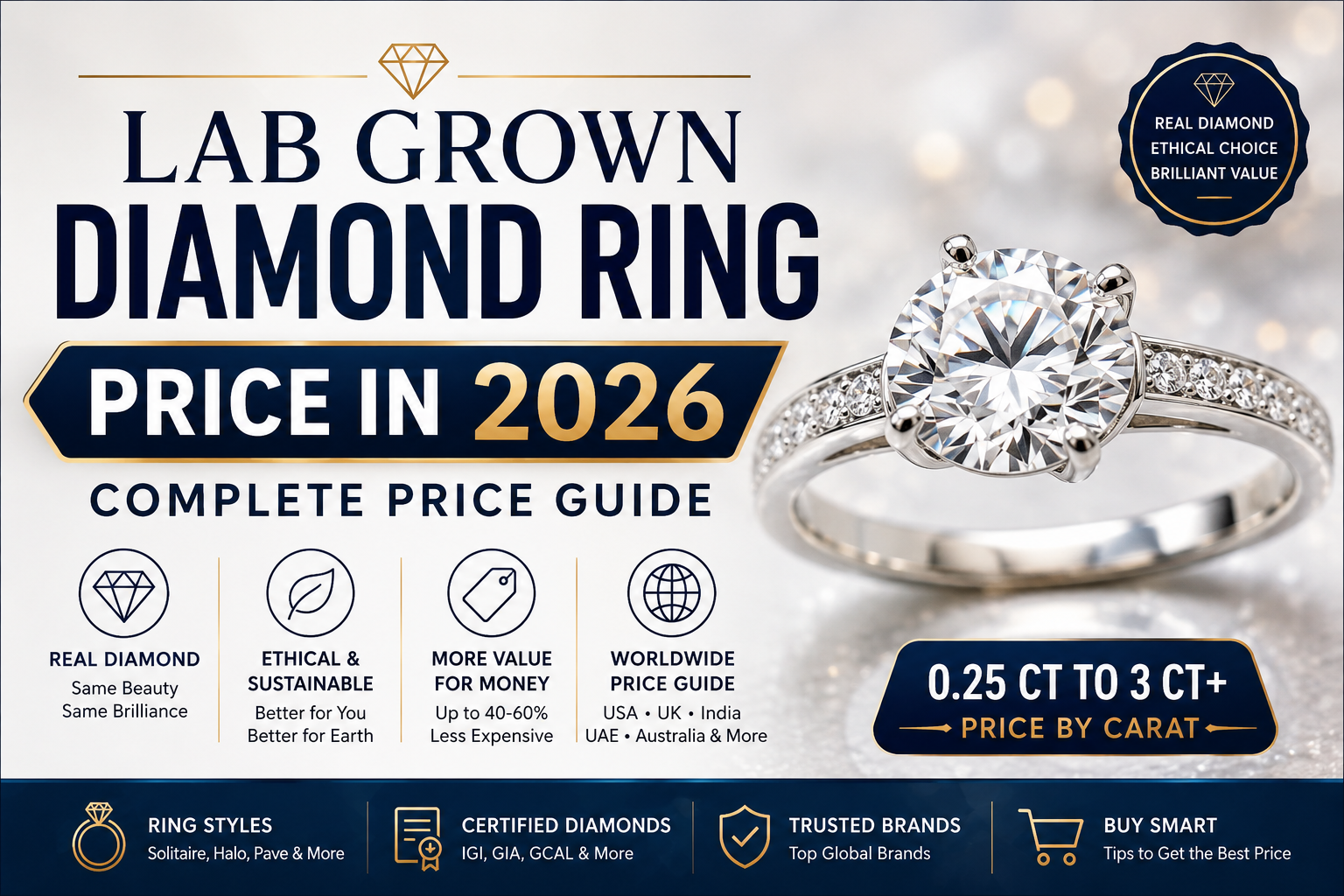
Lab Grown Diamond Ring Price in 2026 – Complete Price Guide
Lab Grown Diamond Ring Price in 2026 – Complete Price Guide
Lab-grown diamond rings have become one of the most popular alternatives to traditional mined-diamond jewelry. In 2026, shoppers can find lab-grown diamond rings at a wide range of prices, depending on the diamond’s carat weight, cut, color, clarity, certification, metal, design, and brand.
For buyers around the world, the biggest attraction is simple: a lab-grown diamond can provide the appearance and physical characteristics of a diamond at a substantially lower price than a comparable mined diamond.
But how much does a lab-grown diamond ring actually cost in 2026?
This guide explains lab-grown diamond ring prices, 1-carat ring costs, prices by carat, factors affecting the final price, certification, popular ring styles, and what buyers should check before purchasing.
Lab Grown Diamond Ring Price in 2026
There is no single worldwide price for a lab-grown diamond ring. Prices vary considerably between retailers and countries.
As a broad consumer guide, a lab-grown diamond ring may range from approximately $300 to $5,000+, while luxury branded or larger-carat designs can cost considerably more.
The diamond itself can represent only part of the final ring price. The setting, gold or platinum, craftsmanship, brand premium, certification, taxes, shipping, and customization can all increase the total cost.
Current market data also shows how dramatically lab-grown diamond prices have changed. Some current price indexes put a 1-carat lab-grown loose diamond around the several-hundred-dollar level, depending on shape and specifications.
Estimated Lab-Grown Diamond Ring Price by Carat
| Diamond Size | Approx. Ring Price* |
|---|---|
| 0.25 Carat | $300 – $900 |
| 0.50 Carat | $500 – $1,500 |
| 0.75 Carat | $700 – $2,000 |
| 1 Carat | $800 – $3,000 |
| 1.5 Carat | $1,200 – $4,000 |
| 2 Carat | $1,500 – $6,000+ |
| 3 Carat | $2,500 – $10,000+ |
*These are broad illustrative retail ranges rather than fixed market prices. Actual prices can be significantly higher or lower depending on specifications, country, retailer, setting and brand.
How Much Is a 1 Carat Lab Grown Diamond Ring in 2026?
A 1-carat lab-grown diamond ring is one of the most searched sizes because it offers a noticeable center stone without the cost associated with a comparable natural diamond.
In 2026, a typical 1-carat lab-grown ring can range from roughly $800 to $3,000, although budget designs can be cheaper and premium designer or platinum rings can be considerably more expensive.
For example, current Indian retail guides show 1-carat lab-grown diamonds and rings at widely varying prices, with some reported ring prices around ₹45,000–₹1,50,000 depending on quality and setting.
The price should therefore never be judged by carat weight alone.
A 1-carat diamond with excellent cut, high color, high clarity and a recognized laboratory report may cost substantially more than a 1-carat diamond with lower specifications.
What Determines Lab Grown Diamond Ring Price?
Several factors determine the final price of a lab-grown diamond ring.
1. Carat Weight
Carat refers to the weight of the diamond, not its physical size alone.
Generally, a larger diamond costs more, although price does not increase in a simple linear relationship.
A 2-carat diamond can cost considerably more than two separate 1-carat diamonds because larger stones are less common in a given quality range.
2. Cut
Cut has a major effect on a diamond’s appearance.
A well-cut diamond can return more light and appear brighter and more attractive.
For an engagement ring, buyers should pay close attention to cut quality rather than choosing a stone based only on carat weight.
3. Color
White diamonds are graded according to how much body color they show.
Higher grades generally command higher prices.
However, the ideal color grade depends partly on the ring setting. A slightly warmer diamond may look different in yellow or rose gold compared with a white-metal setting.
4. Clarity
Clarity describes the presence of internal and external characteristics.
Common grades include:
- IF – Internally Flawless
- VVS1 / VVS2
- VS1 / VS2
- SI1 / SI2
You do not necessarily need the highest clarity grade for a beautiful ring. Many inclusions cannot be seen without magnification.
5. Diamond Shape
Popular lab-grown diamond shapes include:
- Round
- Oval
- Emerald
- Cushion
- Princess
- Pear
- Marquise
- Radiant
- Heart
Shape can influence price because production costs, demand and market availability differ.
Current lab-grown price indexes also show differences between shapes, with 1-carat round, oval, emerald and princess diamonds carrying different average prices.
Lab Grown Diamond vs Natural Diamond Price
One of the primary reasons consumers choose lab-grown diamonds is the price difference.
A lab-grown diamond and a natural diamond are both diamond, but their origins are different. Natural diamonds form naturally underground over geological timescales, while laboratory-grown diamonds are produced using technologies such as CVD (Chemical Vapor Deposition) and HPHT (High Pressure High Temperature).
In many retail comparisons, lab-grown diamonds are substantially less expensive than comparable natural diamonds.
| Feature | Lab-Grown Diamond | Natural Diamond |
|---|---|---|
| Origin | Laboratory | Natural geological formation |
| Chemical composition | Diamond | Diamond |
| Main growth methods | CVD / HPHT | Natural geological process |
| Typical price | Lower | Higher |
| Availability | Increasing | Limited natural supply |
| Certification | Available | Available |
| Resale expectations | Generally weaker | Depends on stone and market |
The price difference can be very large, but buyers should remember that a lower purchase price does not automatically mean better resale value.
Are Lab Grown Diamonds Real Diamonds?
Yes.
Lab-grown diamonds are not simply diamond look-alikes such as cubic zirconia or moissanite. They are laboratory-created diamond material.
GIA explains that laboratory-grown diamonds can be produced through HPHT and CVD processes and that their growth characteristics differ from naturally formed diamonds.
The important distinction is origin, not whether the material is diamond.
CVD vs HPHT Lab Grown Diamonds
There are two major methods used to produce laboratory-grown diamonds.
CVD Diamond
CVD stands for Chemical Vapor Deposition.
The process grows diamond material from a carbon-containing gas under controlled laboratory conditions.
HPHT Diamond
HPHT stands for High Pressure High Temperature.
This method recreates extremely high-pressure and high-temperature conditions that allow diamond material to form.
Both technologies can produce gem-quality diamonds.
GIA research notes that CVD diamonds can also undergo post-growth treatments, including HPHT treatment, to modify certain characteristics.
Lab Grown Diamond Ring Price by Setting
The ring setting can significantly affect the final price.
Solitaire Ring
A solitaire has one primary center diamond.
Typical range: $500–$3,000+
It is one of the most popular choices for engagement rings.
Halo Ring
A halo ring surrounds the center stone with smaller diamonds.
Typical range: $800–$4,000+
The additional diamonds and craftsmanship increase the cost.
Three-Stone Ring
Three-stone designs typically use a larger center stone with two side stones.
Typical range: $1,000–$5,000+
Pavé Ring
Pavé settings use many small diamonds along the band.
Typical range: $800–$4,000+
Gold vs Platinum Lab Grown Diamond Rings
The metal used for the ring also affects the price.
14K Gold
Usually one of the more affordable precious-metal choices.
18K Gold
Contains a higher percentage of pure gold and generally costs more than 14K gold.
Platinum
Platinum is a premium choice and can substantially increase the total price of a ring.
Buyers should therefore compare the complete ring price, rather than comparing only the diamond price.
Lab Grown Diamond Ring Price in India
India has become an important center for diamond cutting and polishing as well as a growing consumer market for laboratory-grown diamonds.
Current 2026 Indian retail guides show broad 1-carat lab-grown diamond ranges from tens of thousands of rupees to well above ₹1 lakh, depending heavily on quality and certification.
A 1-carat lab-grown ring can therefore commonly fall around:
₹45,000 – ₹1,50,000+
The final price depends on:
- Diamond quality
- Ring metal
- Design
- Certification
- Brand
- Making charges
- Taxes
Lab Grown Diamond Ring Price in the USA
The United States is one of the world’s largest consumer markets for lab-grown diamond jewelry.
Retail prices can vary significantly depending on the brand and design.
A simple 1-carat solitaire may cost substantially less than a designer platinum ring featuring a premium-quality center stone.
Buyers should compare:
Diamond price + setting + metal + certification + taxes
rather than looking only at the advertised starting price.
Lab Grown Diamond Ring Price in the UK
In the UK, prices are generally quoted in pounds.
The final cost can be affected by:
- Diamond specifications
- Gold or platinum prices
- VAT
- Retailer margins
- Brand
- Certification
- Ring design
A UK buyer should always check whether VAT is already included in the displayed price.
Lab Grown Diamond Ring Price in UAE and Dubai
Dubai is a major international jewelry market and offers a wide selection of diamond jewelry.
Lab-grown rings are available in different designs, including solitaire, halo and custom-made rings.
When comparing prices in Dubai, buyers should check:
- Diamond certification
- Metal purity
- Diamond weight
- Making charges
- Warranty
- Return policy
- Whether taxes are included
Lab Grown Diamond Brands
The global lab-grown diamond market includes specialist online retailers, traditional jewelry companies and luxury brands.
Examples of brands and retailers that consumers may encounter include:
- Pandora
- Swarovski
- Brilliant Earth
- Clean Origin
- James Allen
- Blue Nile
- Ritani
- CaratLane
- Tanishq
Availability, pricing and product ranges differ by country, so buyers should check the official retailer website in their market before making a purchase.
Does a Lab Grown Diamond Have Resale Value?
This is one of the most important questions buyers should consider.
A lab-grown diamond ring should primarily be purchased for wear, beauty and personal value, rather than as an investment.
Lab-grown diamond prices have experienced substantial declines as production technology and supply have expanded. Current market reporting also highlights very low wholesale prices in parts of the market.
Therefore, consumers should not assume that a lab-grown diamond purchased today will retain its original retail price.
The resale value of the complete ring can also depend on:
- Brand
- Metal
- Diamond quality
- Certification
- Condition
- Current market prices
- Buyer demand
Is a Lab Grown Diamond Ring Worth Buying in 2026?
For many consumers, yes.
Lab-grown diamonds can be particularly attractive if your priority is getting a larger or higher-specification diamond within a fixed budget.
For example, instead of spending a large amount on a smaller natural diamond, a buyer may choose a larger lab-grown diamond and allocate more of the budget toward the ring’s design or precious metal.
However, lab-grown diamonds may not be the best choice for someone whose primary objective is long-term diamond value or the rarity associated with naturally mined stones.
How to Choose a Lab Grown Diamond Ring
Before buying, follow these steps:
Step 1: Set Your Budget
Decide the maximum amount you want to spend on the complete ring.
Step 2: Select the Carat
Choose the approximate size that fits your style and budget.
Step 3: Compare Cut
Prioritize appearance and light performance rather than choosing the largest possible stone.
Step 4: Check Color and Clarity
Do not automatically pay for the highest grade.
Choose specifications that look good to the naked eye.
Step 5: Check Certification
Ask for a recognized laboratory report and verify the report information.
Step 6: Compare the Setting
Compare 14K, 18K gold and platinum options.
Step 7: Check the Return and Warranty Policy
This is especially important when purchasing online.
Step 8: Compare the Complete Price
Look at the total amount, including taxes and other charges.
Why Lab Grown Diamond Prices Keep Changing
The laboratory-grown diamond industry has experienced rapid technological improvements and increasing production.
As production becomes more efficient and supply expands, prices can change quickly.
This means an article or price guide published several years ago may no longer reflect current market conditions.
For this reason, consumers should treat online price ranges as a guide and check current retailer prices before purchasing.
Lab Grown Diamond Ring Buying Checklist
Before placing an order, check:
☑ Carat weight
☑ Diamond shape
☑ Cut quality
☑ Color grade
☑ Clarity grade
☑ Certification
☑ CVD or HPHT origin, where disclosed
☑ Ring metal
☑ Total carat weight
☑ Brand
☑ Warranty
☑ Return policy
☑ Shipping
☑ Taxes
☑ Final price
Frequently Asked Questions
What is the average price of a lab-grown diamond ring in 2026?
A lab-grown diamond ring can range from several hundred dollars to several thousand dollars. A 1-carat ring commonly falls somewhere around the $800–$3,000 range, but the actual price depends heavily on diamond quality, setting, metal, certification and brand.
How much is a 1-carat lab-grown diamond ring?
A 1-carat lab-grown diamond ring may cost approximately $800–$3,000 in many retail markets, although premium and budget options can fall outside this range.
Are lab-grown diamonds cheaper than natural diamonds?
Generally, yes. Lab-grown diamonds are typically much less expensive than comparable natural diamonds, although the exact difference depends on quality and retailer.
Are lab-grown diamonds real diamonds?
Yes. Lab-grown diamonds are diamond material produced in a laboratory rather than formed naturally underground.
Which is better, CVD or HPHT?
Neither method is automatically better. The quality of the finished diamond matters more than simply choosing CVD or HPHT.
Do lab-grown diamonds lose value?
They can. Lab-grown diamond prices have fallen significantly in recent years, so buyers should not purchase one expecting guaranteed investment returns.
Is a 1-carat lab-grown diamond good for an engagement ring?
Yes. A 1-carat lab-grown diamond is a popular engagement-ring size and can provide a larger-looking center stone at a lower price than many comparable natural diamonds.
Final Verdict
The Lab Grown Diamond Ring Price in 2026 depends on far more than carat weight.
For a budget-conscious buyer, lab-grown diamonds can offer the opportunity to purchase a larger or higher-quality diamond without spending as much as a comparable natural diamond.
A practical budget for a 1-carat lab-grown engagement ring is often around $800–$3,000, but buyers should always compare the complete ring specifications rather than relying on a headline price.
Most importantly, check the 4Cs, certification, metal, setting, warranty and return policy before buying.
If your priority is maximum size and visual appearance for your budget, a lab-grown diamond can be an attractive choice in 2026. If rarity, natural origin and long-term market value are more important to you, a natural diamond may be preferable.
Prices change frequently, so always verify the current price and certification with the retailer before purchasing.