How to Open a CNG Pump in India (2026): Step-by-Step Guide
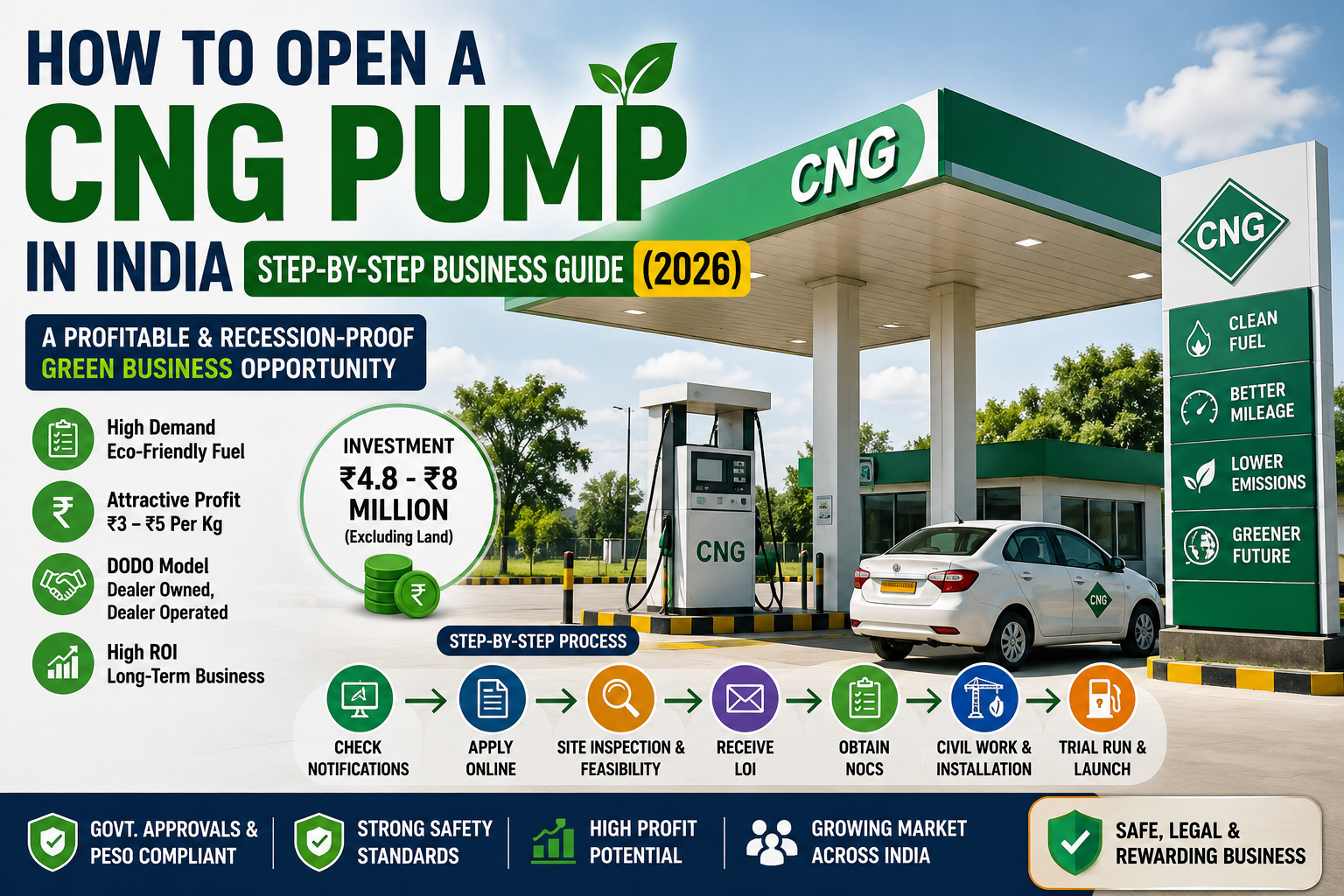
Complete guide to opening a CNG pump in India, including eligibility, investment, land requirements, approvals, and application process.
How to Open a CNG Pump in India: Step-by-Step Business Guide (2026)
With India’s aggressive push toward green energy and reducing carbon footprints, the demand for Compressed Natural Gas (CNG) has skyrocketed. Over the last few years, commercial vehicles, buses, auto-rickshaws, and private cars have transitioned to eco-friendly fuel.
Despite the booming demand, there remains a massive gap in supply infrastructure. To bridge this, major city gas distribution (CGD) companies are actively rolling out new dealerships. If you are looking for a highly profitable, recession-proof business idea, learning how to open a CNG pump in India could be your gateway to long-term wealth.
Most companies in India operate on the DODO Model (Dealer Owned Dealer Operated). This layout means you provide the land and clear the civil work, while the gas utility company sets up the expensive specialized compressors, storage cascades, and dispensing machines.
🏗️ Understanding the Types of CNG Stations
Before applying, you must understand that not all CNG stations operate the same way. Gas companies allocate stations based on pipeline availability near your plot:
- Online Stations: These are directly connected to the city’s main underground natural gas pipeline. They have a continuous, uninterrupted supply of gas and offer the highest profit margins because there are no transportation hassles.
- Mother Stations: These are also connected to the pipeline network but have massive compression systems. They don’t just sell gas to customers; they also fill heavy mobile cascades (gas cylinders on trucks) to supply other smaller stations. These require the largest land footprints.
- Daughter Booster Stations: These are established in areas where underground pipelines have not yet arrived. Gas is brought to your site via specialized trucks (cascades). A booster compressor at your station then pumps the gas into vehicles.
Baseline Eligibility Criteria
Before moving forward with documentation, you must satisfy the baseline statutory eligibility requirements set by the Ministry of Petroleum and Natural Gas:
| Parameter | Mandatory Requirement |
|---|---|
| Nationality | Must be a permanent resident and citizen of India. |
| Age Limit | Minimum 21 years and maximum 60 years at the time of online application. |
| Educational Qualification | Minimum 10th Standard (Matriculation) pass from a recognized board. |
| Property Standing | Land must be self-owned or held via a registered lease for a minimum of 15–30 years. |
Land Selection and Dimension Framework
Your plot must adhere strictly to the safety layouts issued by the PESO (Petroleum and Explosives Safety Organisation) and local development authorities:
- Urban / City Limits: A minimum area of 1,000 to 1,500 square metres.
- National / State Highways: A minimum area of 2,000 to 4,000 square metres.
- Frontage (Road-facing Width): The main road-facing cut must be at least 35 to 45 metres wide to prevent safety bottlenecks and manage vehicle queue spillover.
- Zoning Clearances: The land must not be under forest protection or restricted agricultural zones. If it is registered as agricultural land, you must secure a CLU (Change of Land Use) certificate to legally convert it to Non-Agricultural (NA) commercial status.
💰 Capital Expense and Cost Breakdown
While the exact cost changes depending on land values and local raw material pricing, here is a realistic estimated cost breakdown for a standard DODO Model station (assuming you already own or lease the land):
| Expense Head | Estimated Cost (INR) | Description |
|---|---|---|
| Refundable Security Deposit | ₹5,000,000 – ₹1,000,000 | Paid directly to the CGD gas entity. |
| Civil Infrastructure Work | ₹2,500,000 – ₹4,000,000 | Paving, boundary walls, sales office, canopy foundations. |
| Electrical Infrastructure | ₹1,000,000 – ₹1,500,000 | High-power transformer setup, industrial wiring, panels. |
| Licensing, NOCs, & Legal Fees | ₹300,000 – ₹500,000 | Fire clearance, PESO evaluation, local municipal fees. |
| Working Capital & Staff Salaries | ₹500,000 – ₹1,000,000 | Early-stage cash reserve to handle everyday overheads. |
| Total Estimated Investment | ₹4.8 Million – ₹8 Million | Excludes raw land purchase or leasing premiums. |
Earning Expectations & Profit Margins
Profit margins range from ₹3 to ₹5 per Kilogram (kg) of CNG sold, based on your corporate contract agreements and state tax structures. A well-placed highway asset pushing an average of 4,000 kg daily generates a very solid, predictable cash flow.
Step-by-Step Implementation Process
Setting up a fuel station follows a very strict structural pipeline. Here is exactly how the process unfolds:
- Monitor Official Notifications: CGD companies issue location-specific public tenders or Expression of Interest (EOI) announcements in leading regional newspapers and their web portals based on proximity to their underground steel pipelines.
- Submit Online Application: Register on the respective gas distribution company’s portal. Upload exact digital land blueprints, revenue records (Khasra-Khatauni), and pay a processing fee (typically between ₹10,000 to ₹25,000).
- Site Inspection & Technical Feasibility: The gas utility company’s engineering division will inspect your land plots to evaluate the distance from their main pipeline grid, road safety visibility, and high-tension electrical line clearances.
- Issuance of Letter of Intent (LOI): If the plot clears technical scrutiny, the company awards you a formal LOI, giving you the temporary legal backing to acquire local government licenses.
- Securing Statutory NOCs: You will need explicit clearances from roughly 10–12 government bodies, including the District Magistrate (DM), State Pollution Control Board, Fire & Emergency Services, and the highly crucial PESO Explosives License.
- Civil Engineering Work: Post-NOC, you construct boundary grids, paved surface areas, utility rooms, and standard electric substation works. The gas company will then deliver and commission the main booster compressors.
- Final Trial Run: Once the final pressure integration tests and safety validation audits pass, gas delivery is approved for commercial launch.
Official Government and Authorized Portal Links
Do not apply via third-party middlemen or shady agents. You must use the official regulatory board to verify authorization or apply directly to your region’s assigned gas provider:
- Central Government Regulatory Board: Visit the Petroleum and Natural Gas Regulatory Board (PNGRB) to verify which company owns the exclusive legal distribution rights for your specific city or district grid.
- Indraprastha Gas Limited (IGL): For regions covering Delhi, Noida, Greater Noida, Ghaziabad, and parts of Haryana/Rajasthan, submit applications on the IGL Land Application Portal.
- Mahanagar Gas Limited (MGL): For the Mumbai Metropolitan Region, Thane, and Raigad districts, track openings directly via the MGL Portal.
- GAIL Gas Limited: For broad highway corridors and multiple states across central/south India, use the GAIL Gas Corporate Portal.
- Adani Total Gas Limited: For specialized private franchise network expansions, visit the business alliance section on the Adani Total Gas Portal.
🛠️ Pro-Tips Checklist for Successful Operations
If your application gets approved, keep these management strategies in mind to maximize your returns:
- Uninterrupted Power Backup: Ensure you invest in a premium silent industrial generator set. CNG dispensers and compressors cannot tolerate erratic voltage drops or sudden blackouts.
- Value-Added Allies: Allocate small corners of your plot for secondary cash streams like an ATM kiosk, a quick-service coffee counter, or a tyre-pressure maintenance bay. This helps pay your basic electricity bills.
- Staff Training: Handling highly compressed explosive gas requires disciplined handling. Conduct mandatory fire drills and safety workshops for your pump attendants every quarter.
⚠️ Strict Cyber-Fraud Warning and Legal Disclaimer
Critical Fraud Protection Alert: The internet contains numerous sophisticated, deceptive cloning sites (
www.cngpumpdealership-gov.org, www.cngfranchiseindia.in, etc.) that mimic official logos to steal huge registration advances. Never wire processing funds to private individual bank accounts. Authentic entities communicate strictly through secure domain extensions (.com, .net, or .gov.in) and handle verification transparently through their designated corporate offices.Financial and Structural Risk Disclaimer: Starting a CNG fuel station demands serious upfront capital and extensive bureaucracy. Delays in obtaining statutory NOCs or a sudden lack of pipeline line pressure near your property could result in your application being rejected. Before leasing land or handing over token advances, visit your local City Gas Distribution (CGD) regional corporate office to run an official pipeline feasibility check on your plot’s exact coordinates.
❓ Frequently Asked Questions (FAQs)
Q1. Can two partners jointly apply for a single CNG pump dealership?
Ans: Yes, partnership applications are legally valid. However, all partners must individually satisfy the basic criteria regarding age, educational qualification, and clear background checks. A formal partnership deed must be uploaded with the application form.
Ans: Yes, partnership applications are legally valid. However, all partners must individually satisfy the basic criteria regarding age, educational qualification, and clear background checks. A formal partnership deed must be uploaded with the application form.
Q2. How long does the entire setup process take from application to launch?
Ans: On average, it takes anywhere between 9 to 18 months. The time is mostly spent waiting for clearances and NOCs from local municipal departments, highway authorites, and PESO inspectors. The actual physical construction takes just 3 to 4 months.
Ans: On average, it takes anywhere between 9 to 18 months. The time is mostly spent waiting for clearances and NOCs from local municipal departments, highway authorites, and PESO inspectors. The actual physical construction takes just 3 to 4 months.
Q3. Will the gas company pay me rent if I lease my land to them?
Ans: This depends on the business model. Under the DODO model, they do not pay rent; instead, you get a higher commission per kg because you manage operations. Under the CCDO model (Company Owned Dealer Operated), the company might take your land on a fixed monthly rent and pay a smaller operational commission.
Ans: This depends on the business model. Under the DODO model, they do not pay rent; instead, you get a higher commission per kg because you manage operations. Under the CCDO model (Company Owned Dealer Operated), the company might take your land on a fixed monthly rent and pay a smaller operational commission.