How to Start an EV Charging Station Business in India (2026 Costs & Companies)
EV Charging Station Business in India – Investment, Cost, Companies and Setup Guide 2026
How to Start an EV Charging Station Business in India: Setup Costs, Top Companies, & Step-by-Step Guide (2026)
The electric vehicle revolution in India is moving at an unprecedented pace. Backed by the government’s FAME (Faster Adoption and Manufacturing of Hybrid and Electric Vehicles) scheme and state-specific EV subsidies, millions of electric cars, two-wheelers, and commercial three-wheelers are hitting Indian roads every year.
However, the biggest hurdle for EV owners is the lack of public charging networks. This infrastructure gap presents a massive, highly lucrative, and future-proof business opportunity for entrepreneurs and landholders. If you are looking to set up a passive income asset, starting an EV Charging Station is an incredible business venture.
The best part? Unlike traditional petrol pumps or CNG stations, the Indian government has clarified that no separate license is required to operate a public EV charging station, making entry barriers remarkably low.
⚡ Types of EV Charging Infrastructure
Before analyzing the cost matrix, it is crucial to understand the two main categories of charging points:
-
- AC Charging (Slow/Moderate Charging): These utilize alternating current and are primarily designed for two-wheelers, three-wheelers, and long-duration parking spaces (like apartments, offices, or malls). They usually offer 3.3 kW to 22 kW capacities.
- DC Fast Charging (Rapid Charging): These utilize direct current and can charge a modern electric car from 10% to 80% in under 45 minutes. These are highly profitable and are standard setups across national highways, major commercial hubs, and roadside food plazas (ranging from 30 kW to 240 kW or more).
📋 Eligibility and Requirements
While the legal entry barriers are low, your chosen commercial location must fulfill specific structural criteria:
-
- Property Clearance: You must own the commercial plot or possess a registered lease deed for a minimum of 5 to 10 years.
- Space Dimensions: For a standard public station with 3 to 4 charging bays, a minimum area of 500 to 1,000 square feet is needed.
- Power Substation Proximity: The land must have access to a high-voltage commercial power supply or be close to a local DISCOM transformer grid.
- Basic Amenities: Having a clean waiting lounge, clean washrooms, or a café nearby significantly improves customer retention while vehicles are charging.
💰 Investment Breakdown: How Much Does It Cost?
The capital expenditure (CapEx) varies dynamically based on whether you are setting up slow AC units or ultra-fast highway DC chargers. Below is an estimated financial matrix for a Standard Station with 2 DC Fast Chargers (60kW) and 2 AC Chargers (22kW):
📊 Estimated EV Station Cost Table
| Expense Category | Estimated Cost (INR) | Operational Detail |
|---|---|---|
| EV Charger Hardware (Machines) | ₹1,200,000 – ₹1,800,000 | 2x 60kW DC Fast Chargers + 2x AC units. |
| New Electricity Grid Connection | ₹300,000 – ₹500,000 | 100 kW to 150 kW load security deposit & cable drop. |
| Transformer & Stabilizer Unit | ₹400,000 – ₹600,000 | Essential for preventing voltage spikes and managing loads. |
| Civil Infrastructure & Cabling | ₹200,000 – ₹400,000 | Paving, bays marking, heavy-duty underground copper cables. |
| Software, CMS, & App Setup | ₹50,000 – ₹100,000 | Centralized payment gateway and digital user interface app. |
| Working Capital & Maintenance | ₹150,000 – ₹300,000 | Reserve funds to manage初期 overheads and staff payrolls. |
| Total Estimated Investment | ₹2.3 Million – ₹3.7 Million | Note: Excludes land acquisition or lease premium prices. |
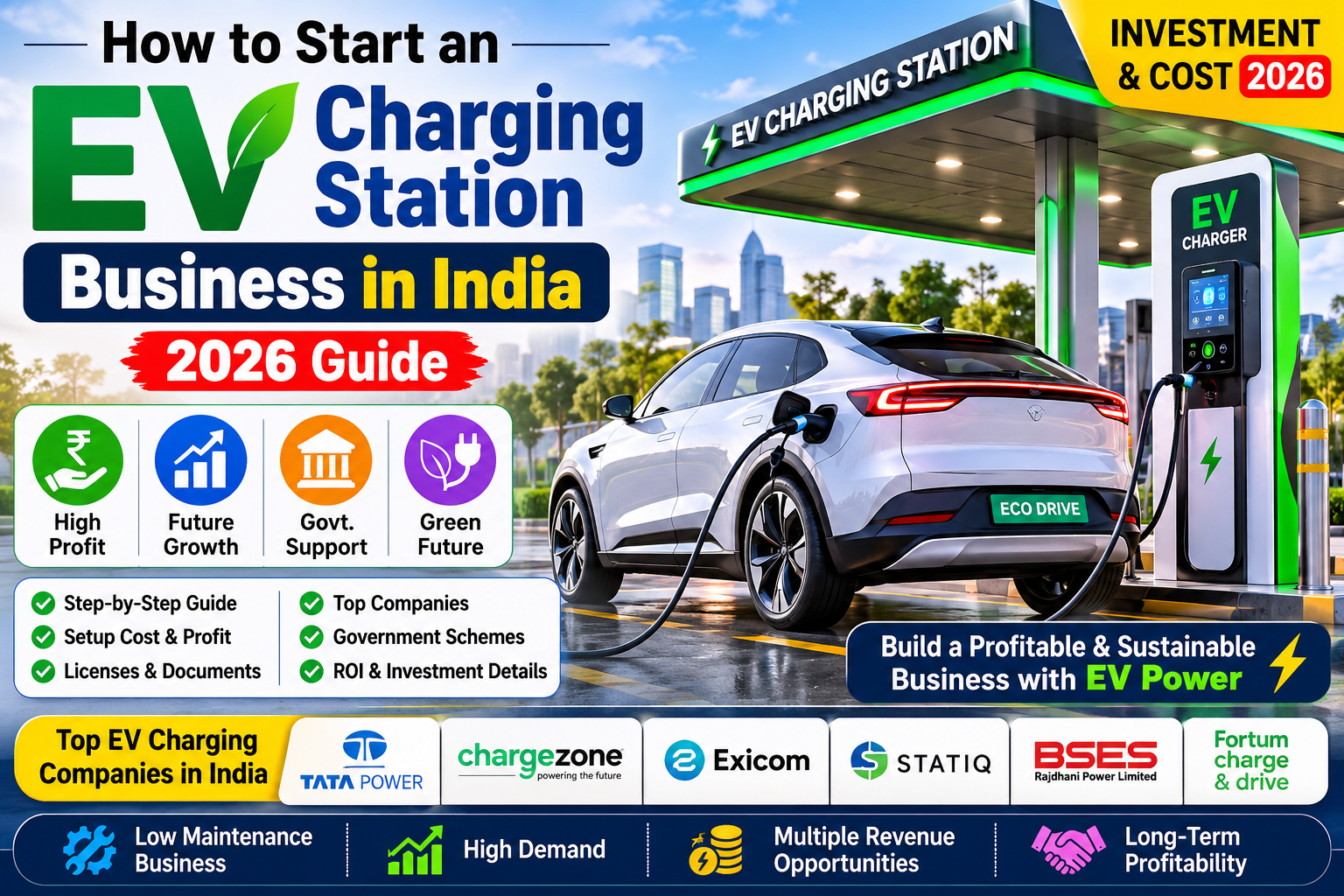
🌐 Top EV Charging Station Provider Companies in India
You can enter this ecosystem through two paths: Franchise Partnerships (where you use their brand and app network) or White-Label / Equipment Purchasing (where you buy the hardware and operate independently).
Here are the official web portals of the dominant market leaders providing EV setups in India:
-
- Tata Power EZ Charge: The largest charging network infrastructure provider in India. Visit their Tata Power EV Franchise Portal to partner for commercial land networks.
- Jio-bp pulse: A major joint venture expanding rapidly across commercial points and fuel bunks. Explore details via the Jio-bp pulse Official Website.
- Adani Total Energies E-Mobility (ATEL): Focusing heavily on fast-charging highway networks. Apply on the Adani EV Charging Network.
- Ather Grid / Stark: Dominating the two-wheeler charging network across major cities. Check their partner framework on the Ather Grid Portal.
- ChargeZone: A premier choice for standard high-speed highway tracking and corporate B2B fleet networks. Connect via the ChargeZone Business Portal.
- Glida (formerly Fortum Charge & Drive): A highly sophisticated multinational public charging operator in India. Check out the Glida EV Platform.
- Government Nodal Agency: For overall national grid standards, charging point definitions, and master plans, track the official Bureau of Energy Efficiency (BEE) portal.
🛠️ Step-by-Step Business Implementation Plan
[Step 1: Finalize Location & Check Local Discom Feasibility]
                             │
                             ▼
[Step 2: Reach Out to Selected EV Brand or Hardware Vendor]
                             │
                             ▼
[Step 3: Apply for an Augmented Commercial EV Power Load from DISCOM]
                             │
                             ▼
[Step 4: Execute Civil Grid Layouts, Transformer Setup, & Paving]
                             │
                             ▼
[Step 5: Install Charging Units & Connect to CMS Network App]
                             │
                             ▼
[Step 6: Run Final Safety Tests, Set Pricing Tariffs, and Open for Public]
-
- Run Site Feasibility Checks: Confirm that your site has ample entry and exit clearance. Take your land survey documents to the local power board (DISCOM) office to ensure the nearby grid lines can handle a 100kW+ load addition.
- Onboard a Partner Company: Reach out via the company links above. Submit your site photos, coordinates, and structural dimensions. They will verify whether the location falls inside a high-traffic zone.
- Secure Power Load Allocation: Apply for a dedicated EV Tariff Connection from your state electricity board. Most state governments offer heavily subsidized electricity rates for public EV charging stations.
- Execute the Site Work: Build the elevated charging platforms, complete the safety fencing, install earthing pits, and set up your industrial stabilizer units.
- Integration of the App Network: Connect your hardware with a Charging Station Management System (CMS) software. This enables users to locate your station on Google Maps, check real-time bay availability, and pay digitally through an app wallet.
⚠️ Operational Safety Advice and Business Disclaimer
Cyber-Security & Machine Safety Warning: With the boom in clean energy, be cautious of fake web links online that claim to allocate “Government-Subsidized EV franchises” for advance processing fees. Deal strictly with certified field engineers and registered company domains. Ensure your site uses automated circuit breakers to protect against voltage surges or heavy rains.
Financial and Structural Risk Disclaimer: Opening a public EV charging asset requires careful long-term planning. Your ultimate returns depend on user adoption speeds in your local region, changes in state-level commercial electricity pricing, and vehicle footfall. Always execute a comprehensive vehicle flow analysis of the area before signing long-term lease agreements or purchasing expensive fast-charging hardware.